
About the Institute for Health Policy
Purpose
The Institute for Health Policy gives communities across the Houston region and Texas reliable information about their own health. Working chiefly through large-scale sample surveys, the Institute measures unmet health needs and documents how geographic, social and economic disparities shape health, health care and access to it. We translate these findings into clear, dependable information that residents, community organizations, practitioners and policymakers can use to set priorities and improve the public’s health.
Mission
- Measuring community health to provide reliable, local data on unmet health needs and to document how geographic, social and economic disparities shape health and access to care across the region.
- Analysis to turn survey findings into useful and reliable knowledge about health needs, trends and disparities at the county, city and neighborhood levels, so communities and decision-makers can target resources where they are needed most.
- Design and Development to develop effective strategies for the design, communication and dissemination of viable policy solutions and to build the collaboration necessary to make those solutions more effective.
- Education and Communication to equip the next generation of health policy leaders with the skills necessary to use scholarly inquiry and to inform research questions with policy knowledge.
Shared Survey Infrastructure for the Region
Sound population data is expensive to collect, and few organizations can field a rigorous survey on their own. The Institute maintains shared survey infrastructure for the region: sampling expertise, established questionnaires, trusted relationships with communities, and public data files, so that health departments, hospitals, foundations and community groups can draw on common, comparable information rather than each building that capacity from scratch.
Because the data are gathered to a common standard and made freely available, they can answer questions as they arise, where needs are greatest, which groups face the widest gaps, and how conditions change over time. The Institute works with data users to translate these findings into clear information for community planning, program design and policy, keeping the connection between rigorous measurement and practical decision-making.
Health of Houston Survey
Overview
The Health of Houston Survey (HHS) is the largest health survey of adults and children in Harris County and the City of Houston. The survey is a valuable source of statistics on health, health care and insurance, cancer screening, mental health, health behaviors and neighborhood conditions at county, city and neighborhood levels. The HHS is used for documenting unmet needs, identifying disparities in health, resource targeting, documenting community benefits and strategic planning. In each survey, a representative sample of residents of the Houston area across sub-county areas, as well as across groups defined by race and ethnicity, poverty level and gender, is selected and interviewed. The first HHS was conducted in 2010, the second was completed in 2018. You can review our most commonly asked questions in our FAQ Sheet.
The third Health of Houston Survey has been completed in 2026. Survey data will be free and accessible through a web-based, interactive and user-friendly interface, RDS.
RDS currently holds four of our surveys: the Health of Houston Surveys of 2018 and 2026 and the COVID Impact Surveys of 2024 and 2025. Survey metadata and downloads are available at this site. (Link to the landing page)
The Houston Endowment and UTHealth supported the survey in 2010. Support for the 2018 survey was provided by:
Houston Endowment
Episcopal Health Foundation
Texas Children’s Hospital
Memorial Hermann Health System
Community Health Choice/Harris Health System
UTHealth, President’s Excellence Fund
UTHealth School of Public Health, Office of the Dean
Texas Medical Center, Health Policy Institute
The Episcopal Health Foundation and the Texas Epidemic Public Health Institute supported the 2026 Health of Houston Survey.
The COVID Impact Surveys were supported by the Centers for Disease Control and Prevention and the City of Houston Health Department.
The COVID Impact Surveys, the Health of Houston 2026, and the Fort Bend Community Health Assessment were completed in partnership with the Houston Population Research Center, Kinder Institute for Urban Research, Rice University. Together, we have built, expanded and maintained the Greater Houston Community Panel.
Special Features of the 2018 Health of Houston Survey:
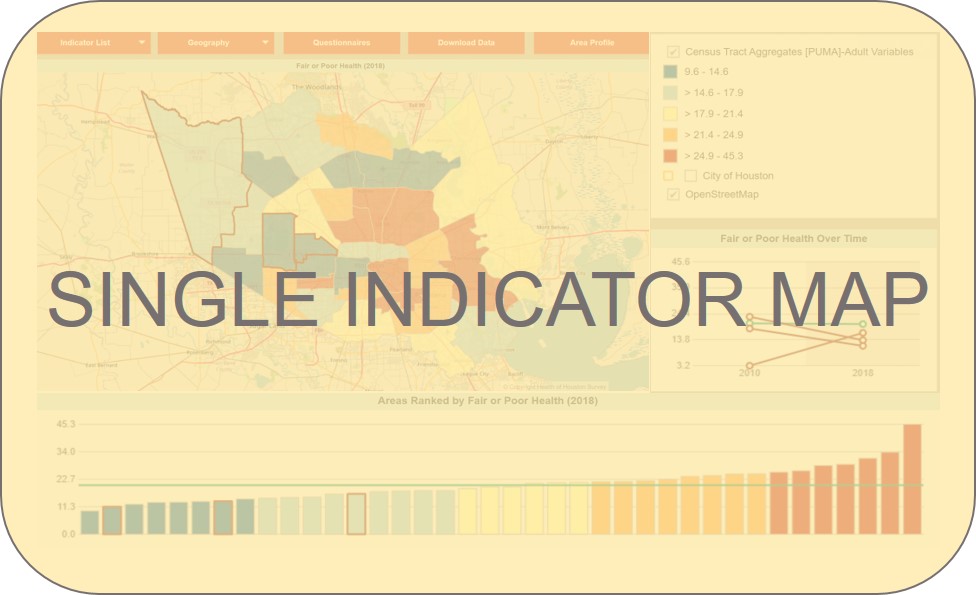
Maps of Health Indicators
View the Single Indicator Map in InstantAtlas, which includes area percentages, maps and rankings. There is an exporting option available for presentations. For more information about how to use InstantAtlas, click here.
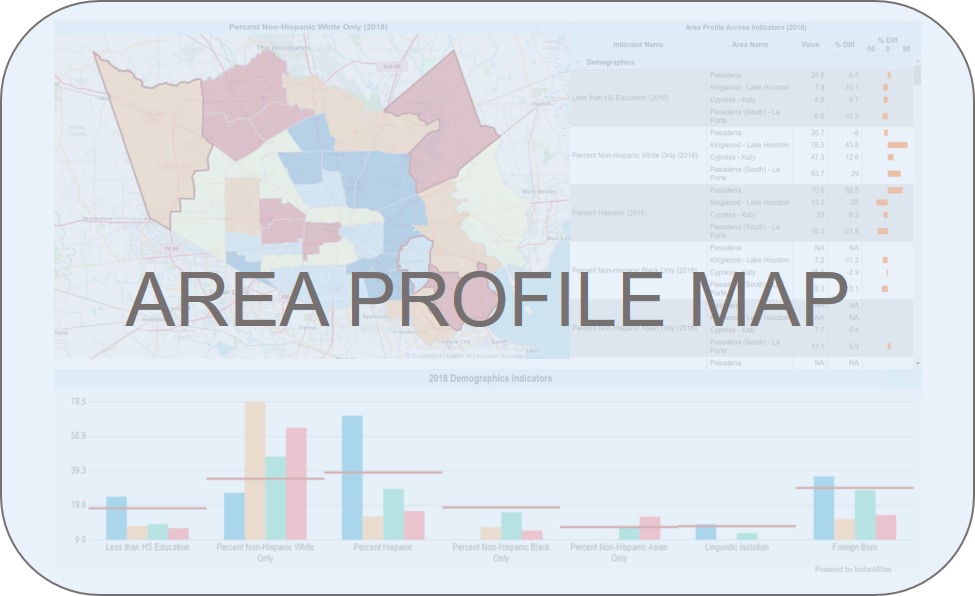
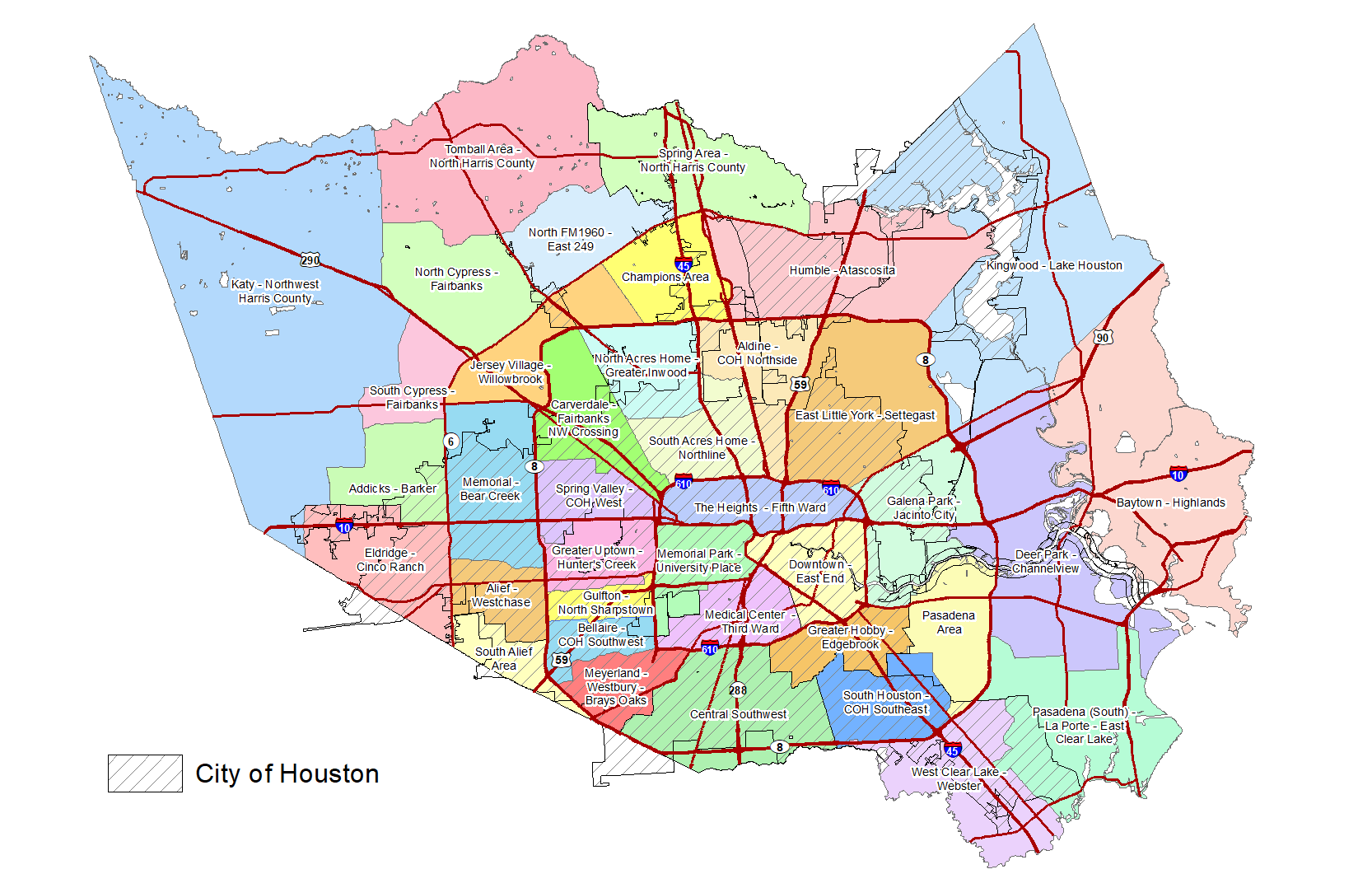
View the Area Profile Map in InstantAtlas, which includes sub-county area profiles. The 2018 data and a new geography of 38 Harris County Public Use Microdata Areas have been added. For updates, please contact us at [email protected].
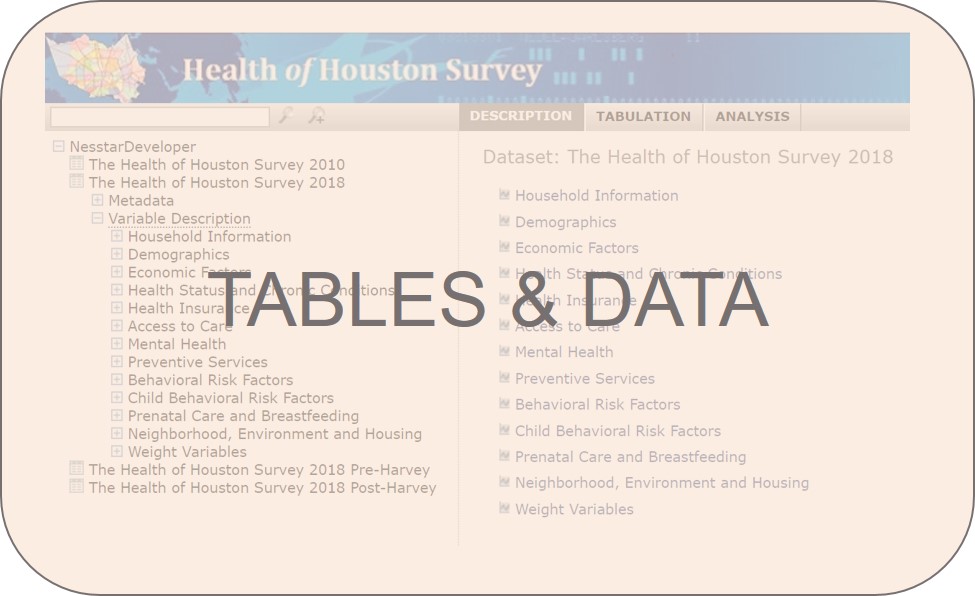
Tables and Data
View the data and construct tables in Nesstar. To download the data in Nesstar, complete public use file data agreement form and send it to [email protected].
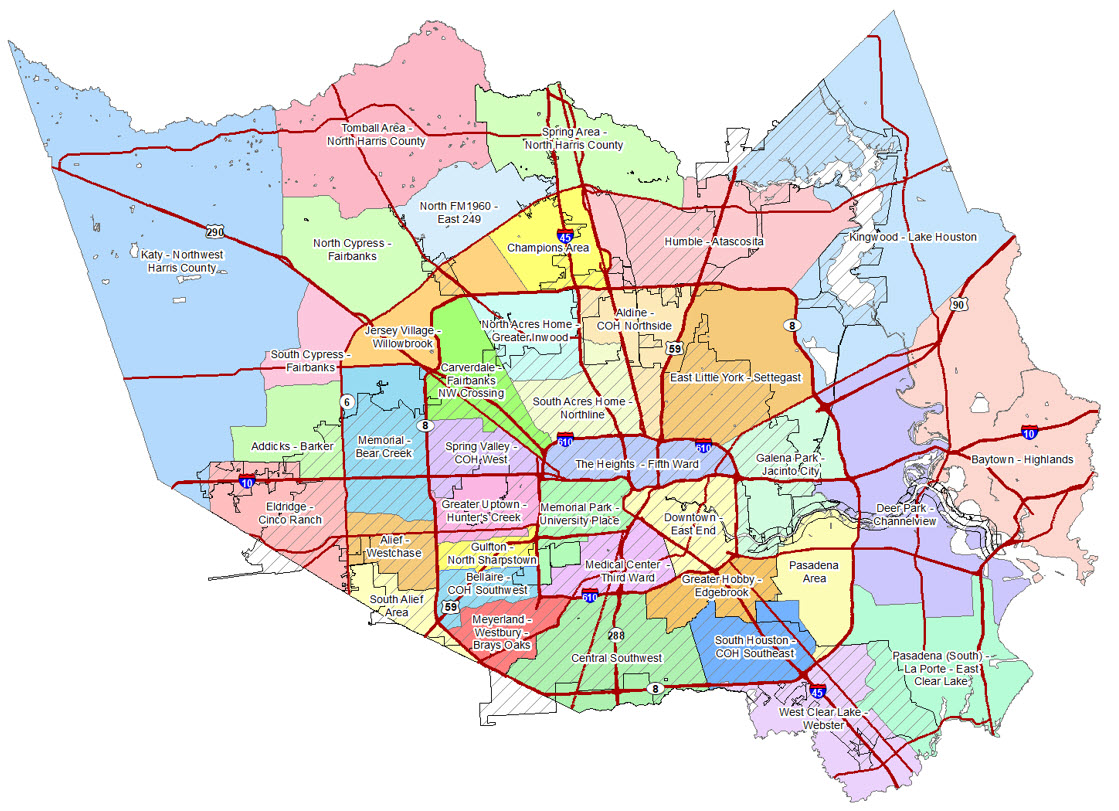
PUMA Aggregated Estimates
We have aggregated survey data into 38 US Census Public Use Microdata Areas (PUMAs) to facilitate the use of health indicators at subcounty level. Get the estimates.
HHS Methodology
In 2017-18, HHS employed a dual-frame Random Digit Dialing sample design, using a combination of landline phones and cellphones. Half-way to completion, in August 2017, it had to pause due to Harvey-related flooding. The survey resumed again in February 2018, at which time questions on how the Hurricane impacted the lives of Houstonians, such as flooding and property damage, income, employment, evacuation, assistance/aid and recovery, were added. Few questions that were not part of core questionnaire were eliminated.
HHS Questionnaires and Codebooks
The 2018 questionnaire is largely based in 2010 questions, the core of which we preserved for data comparability across years. New items were solicited via email from all the stakeholders involved in providing topics in 2010 and data users. Flooding from Hurricane Harvey prompted the need to add new Harvey-related questions mid-survey, which were asked to the sample interviewed six to nine months after Harvey.
The HHS questionnaire was created to match the health information needs of organizations that work to improve Houston area residents’ health. In 2009, we invited local organizations and health authorities to provide suggestions on topic priorities. We also solicited suggestions based on community priorities from all Super Neighborhood Councils in the City of Houston and the civic associations. To see a summary of the results of the feedback please see our Input Summary Fact Sheet, or read more about the questionnaire development.
- 2018 Topics
- 2018 Phone (CATI) questionnaire
- 2010 Topics
- 2010 Phone (CATI)/web questionnaire
- 2010 Mail questionnaire
Mapping the Houston Area
HHS 2018 Files
- Mapping the Houston area by PUMAs (Excel file)
- HHS 2018 PUMAs (map)
HHS 2010 Files
- Mapping the Houston area by zip code (Excel file)
- Copies of UTHealth School of Public Health files for mapping programs (zip file)
- Zip code areas (letter-size, legal-size)
Survey Reports
The Health of Houston Survey presentations, reports, questionnaires and survey promotional materials are available for download and printing.
- HHS2018 Summary Report
- HHS2018 Methodology Report
- HHS2010 Summary Report
- HHS2010 Methodology Report
- Stakeholders’ Input Summary
- Assessing Health Information Priorities of Stakeholders and Community Groups in Houston
Key faculty and staff for the 2018 Survey
- Stephen Linder, PhD - Faculty and Principal Investigator
- Dritana Marko, MD - Faculty and Project Director
- Jessica Tullar, PhD - Faculty and Survey Epidemiologist
- Tom Reynolds, PhD - Research and Technical Support
- Patty Poole - Administrative Support
Key faculty and staff for the 2024-26 Surveys
- Stephen Linder, PhD - Faculty and Principal Investigator
- Luis Leon Novelo – Faculty and Statistician
- Weijia Hu – Graduate Assistant and Data Analyst
Mailing address
Institute for Health Policy
The University of Texas School of Public Health
P.O. Box 20186
Houston, TX 77225
Email: [email protected]
COVID Impact Surveys
Overview
The COVID Impact Surveys measured how the pandemic affected the health and circumstances of Houston-area residents—physical and mental health, household finances and employment, and, for families with children, how children experienced and coped with the disruption. Like the Institute’s other surveys, they were fielded through the Greater Houston Community Panel, built to reflect the socio-demographic makeup of the community as accurately as possible, so the results show how the pandemic’s burden was distributed across geographic, social and economic lines. Public Use Data Files are available below.
First Covid-19 Survey
- Questionnaire
- Codebook
- Data and variables
Second Covid-19 Survey
- Questionnaire
- Codebook
- Data and variables
Overview

The Greater Houston Community Panel is the standing sample the Institute uses to collect timely health information from across the region between large surveys. It is a joint initiative of the UTHealth Houston Institute for Health Policy (at the School of Public Health), the Rice University Kinder Institute for Urban Research, and the Houston Health Department.
Panel members are randomly selected adults who, taken together, reflect the social, economic and demographic makeup of the Houston community. Members are invited to take short surveys on health and related topics, responding by web or phone in English or Spanish. Because the panel is built to be representative, its results can be read as estimates for the wider community rather than the views of those who happen to volunteer.
Panel surveys let the Institute track unmet health needs and the geographic, social and economic disparities behind them between the larger Health of Houston Surveys, and to add timely questions when new needs emerge. Public Use Data Files from each survey are posted below so that health departments, community groups and other organizations can use the findings in their own planning.
The project is funded by the U.S. Centers for Disease Control and Prevention through a grant from the Houston Health Department. Listed below are surveys fielded to the Greater Houston Community Panel with PUDFs available here. Read more about the panel and other surveys from our partners at Rice University.
Population Survey Repository
The Population Survey Repository is the public home for the survey data the Institute collects across the region. From here you can download Public Use Data Files from the Health of Houston and COVID Impact Surveys, together with the documentation needed for community groups, agencies and researchers to analyze unmet needs and the geographic, social and economic disparities the data reveal. Additional surveys will be added as they become available.
Our Recent Assessments
Current areas of focus include: improving the evidence base of health policymaking, population studies on health needs, enhancing regulatory science and environmental health policy, innovations in interprofessional education for the next generation of health professionals, and access to health care, both nationally and internationally.
City and state analysis
Fort Bend County Health Assessment 2024 press release
COVID Impact Surveys 2024, 2025
2026 Health of Houston Survey
2018 Health of Houston Survey press release
2018 Harvey Report press release.
Mapping risk factors for severe COVID-19 in Texas metro areas
The Institute for Health Policy created maps of the risk factors associated with severe COVID-19 disease for cities and counties in Texas.
COVID-19 Fact Sheets
Update of COVID-19 Severity in Houston Area Fact Sheet (en)
COVID-19 Severity in Harris County Fact Sheet (en)
COVID-19 Severity in Dallas, Austin and San Antonio Fact Sheet (en)
COVID-19 Severity in Dallas, Austin and San Antonio Fact Sheet (es)
From the archives:
A Closer Look at Air Pollution in Houston: Identifying Priority Health Risks (Report of the Mayor’s Task Force on the Health Effects of Air Pollution)
Knowledge Translation Podcast
A core mission of the Institute for Health Policy is find ways to “bridge” the gap between public health researchers and decision-makers in health policy by translating science-based knowledge into meaningful information for action. In the early 1990s, the first systematic initiatives in this knowledge translation task were undertaken by Canadian research institutions and grant-makers. Their concepts of translation and exchange eventually crossed the 48th Parallel to be split into two activities, known by US grant-makers as Community Engagement and Implementation & Dissemination. While there is some overlap, not all of the Canadian experience in KT was adopted here.
Through our knowledge translation (KT) audio podcast series, we want to preserve the insights, experience and lessons learned by those who were part of the founding efforts in KT and to supplement these with complementary perspectives from practitioners in the US. You will find sixteen 30-minute episodes, recorded and edited here at the IHP. Brief descriptions of the speakers and links to their conversations appear below. All of the podcasts are free to stream or to download.
Listen to Let's Talk KT - Knowledge Translation in Public Health
Health Policy Streaming Course
In the Fall of 2017, Drs. Linder and Garson, then with the Health Policy Institute of the Texas Medical Center, convened a planning group to develop a course in healthcare policy that would engage volunteers from TMC member institutions. The idea was to take on pressing policy issues affecting TMC institutions, pose questions, and facilitate a discussion between expert panelists and a live audience. The 90-minute sessions were live-streamed and recorded. Seven TMC academic institutions adopted the course for graduate credit and supplemented the recorded sessions with discussions and supplemental readings, identified by the panel participants each week.
The course was offered in 2018 and 2019, consisting of 13 weekly sessions each year. The topics changed from year-to-year, as did the panelists, but the audience engagement remained central. The IHP is pleased to host all 26 sessions, as the topics remain timely.
TMC Health Policy Course 2019
Co-Directors, Stephen H. Linder, Ph.D. and Arthur "Tim" Garson, Jr. MD, MPH, MACC
Weeks 1 - 13
Week 1: Debunking the Health Policy Myths
Week 2: State and Local Health Policy Objectives and Methods
Week 3: How Health Policy is Made
Week 4: Access to Care and Health Insurance Coverage
Week 6: Financing, Payment and Cost
Week 8: The Public Health System
Week 9: U.S. Health Policy Methods
Week 10: Social Determinants of Health
Week 11: Ethical Dilemmas in Health Policy
Week 12: Health Care Workforce
Week 13: National Health Reform
TMC Health Policy Course 2018
Co-Directors, Stephen H. Linder, Ph.D. and Arthur "Tim" Garson, Jr. MD, MPH, MACC
Weeks 1 - 13
Week 1: Beliefs and Myths About U.S. Health Care
Week 2: State and Local Health Policy Objectives and Methods
Week 3: How Health Policy is Made
Week 4: Access to Care and Health Insurance Coverage
Week 5: Financing, Payment, and Cost
Week 8: The Public Health System
Week 9: U.S. Health Policy Methods
Week 10: Social Determinants of Health
Week 11: Ethical Dilemmas in Health Policy
Contact us
IHP Mailing Address
Institute for Health Policy
The University of Texas School of Public Health
P.O. Box 20186
Houston, TX 77225
Director and Professor
Stephen H. Linder, PhD
[email protected]
713-500-9494