
About Health of Texas
-
Is Health of Texas the same as Texas CARES?
Health of Texas is the next stage for Texas CARES! Health of Texas will look into other chronic diseases, such as heart disease, cancer, and more.
-
Why should I participate in Health of Texas?
If you decide to be part of Health of Texas, you will be eligible to receive additional surveys about your health.
Another exciting addition with Health of Texas is that, if you consent, we will be able to connect your existing health-related claims records (meaning, moments when you used your insurance) with your account with us! This will give us the opportunity to learn more about trends in health care, such as health use, health costs, treatments, and more.
Participating in Health of Texas is a way to be part of something even bigger. You will contribute to understanding the state of health in Texas!
-
How do I participate in Health of Texas?
The Health of Texas team sent out invitations to Texas CARES participants who have taken at least one survey. We are not enrolling new participants at this time. If you receive an invitation, please complete the consent form. You will be invited to complete at least one survey. We may contact you for future opportunities. Participating in Health of Texas does not take up very much of your time.
-
Can I be part of Health of Texas if I do not have health insurance?
Yes, you can still join Health of Texas if you do not have health insurance.
-
Can I invite someone new to be part of Health of Texas?
We are not currently accepting new participants for Health of Texas. You can check for information about new enrollment on our website or stay subscribed to texts and emails for updates.
-
Why was I not invited to be part of Health of Texas?
Thank you for your interest! At the moment, only Texas CARES participants who have completed at least one survey with us are eligible to participate in Health of Texas. If this applies to you and you did not receive an invitation, please reach out to the team at [email protected]. You can check for information about new enrollment on our website or stay subscribed to texts and emails for updates.
-
Why do I need a password for the Health of Texas elements pages?
The Health of Texas Community, Health of Texas Data and Health of Texas Horizon pages are for participants only. Participants will receive the password for these pages at the end of their completed consent form once they join Health of Texas. Please treat this password like you would any other, and do not share it with anyone else. If you have lost or forgotten your password, please email the team at [email protected].
-
What is the best way to receive updates about Health of Texas?
Stay subscribed to Health of Texas text messages and emails — remember, you will receive emails from [email protected] now. You can also follow us on social media and check back here on the website for the latest updates on the program.
-
How do I contact the Health of Texas team?
You can contact the Health of Texas team by email at [email protected] or by leaving a voicemail on our secure line at 713-500-9441. We will reach out to you as soon as possible.
About Health of Texas Community
-
Someone I know got an invitation for Health of Texas, but I didn’t — even though I completed at least one survey during Texas CARES. How can I join?
We are sending out invitations throughout the following weeks. If you have not received an invitation by the end of the summer, please contact the team at [email protected].
-
Will I still get antibody tests through Health of Texas?
At this time, Health of Texas does not have details on additional COVID-19 antibody tests. Stay subscribed to Health of Texas text messages and emails for any future updates.
-
How do I update my survey or information if anything changes?
If your contact information, insurance or anything else you answered in the survey changes after you complete your survey, please email Health of Texas at [email protected].
-
Will my information be shared with anyone?
Your personal information will not be shared with anyone outside of the Health of Texas team.
-
Where do I go to get my Health of Texas: Bridge 1 testing done?
Health of Texas participants selected for Health of Texas: Bridge 1 testing will receive a test order number by text once they consent to take part in the Bridge testing. Participants will go to their local CPL to complete the blood draw.
Important: Health of Texas samples cannot be collected at CPL’s Pearland PSC. Please choose an alternative location, such as Lake Jackson PSC or Almeda PSC, to complete your Bridge testing. Search for other CPL locations here: https://www.cpllabs.com/locations/
Note: CPL's Lubbock PSC is available for testing, though this location may not have been originally included in the CPL location search.
Read more about Health of Texas Bridge: go.uth.edu/Bridge
-
What do my Health of Texas Bridge 1 – Inflammation test results mean?
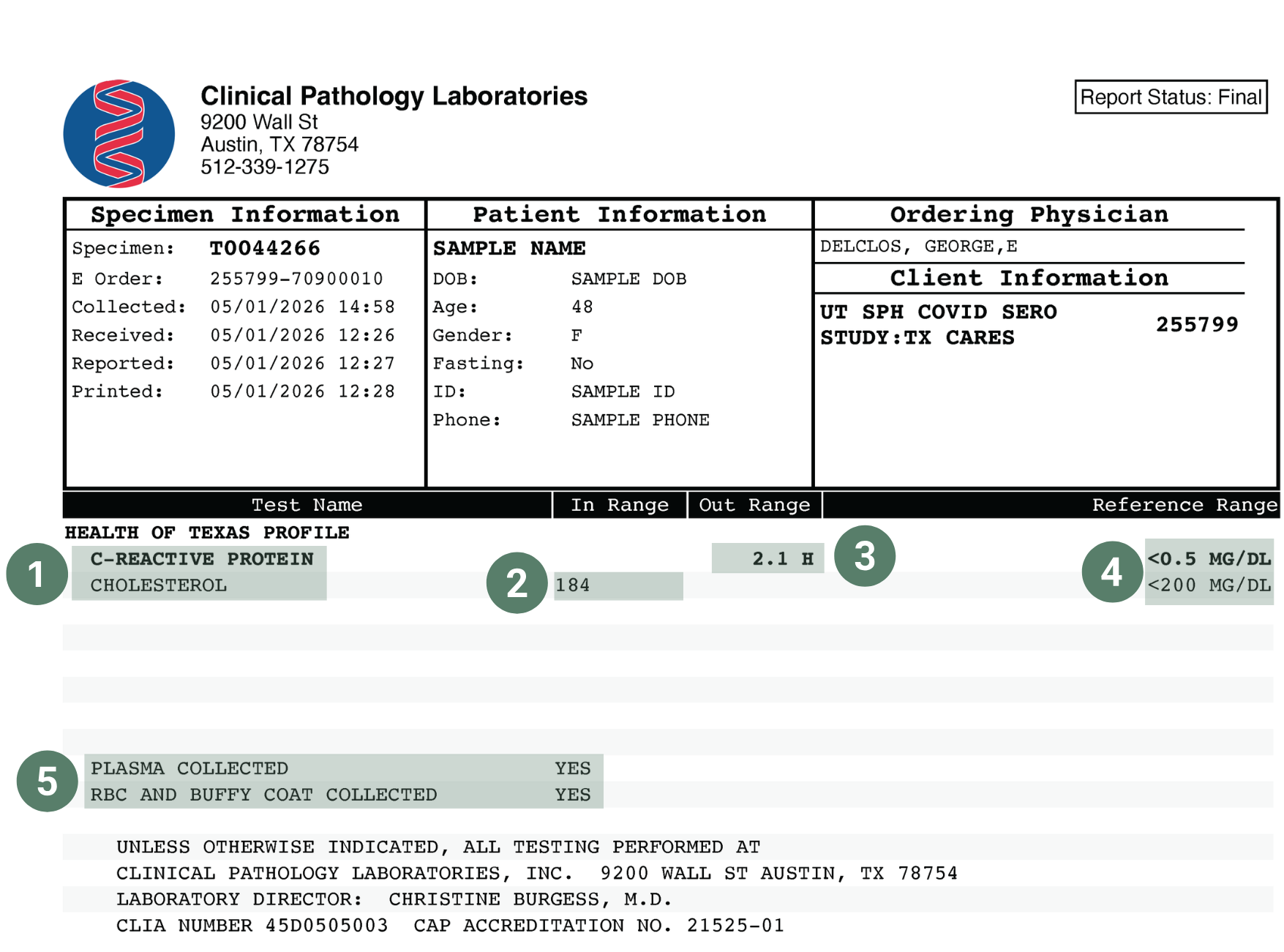
Above is a sample report that CPL will send to participants after Health of Texas Bridge 1 - Inflammation testing is complete. Below is additional information about each numbered area of the report:
- These are the tests that Bridge 1 is conducting. The C-Reactive Protein (CRP) test indicates inflammation. The cholesterol test can help measure the risk of heart and blood vessel diseases.
- This sample result falls within the cholesterol reference range (it is less than 200 mg/dL), so it appears beneath the “In Range” column on the report.
- This sample results falls outside the CRP reference range (it is greater than 0.5 mg/dL), so it appears beneath the “Out Range” column on the report.
- The “Reference Range” column on the report shows the range that is considered normal for the tests. A normal CRP test would be less than 0.5 mg/dL. A normal cholesterol test would be less than 200 mg/dL.
- This part of the report shows “yes” on both items for sample storage and the Alamar inflammation panel.
Please note: The Health of Texas team cannot provide health or medical information — or personalized result interpretation to participants. If you have questions about your test results, contact your doctor.
-
I’m having trouble accessing my Health of Texas Bridge results from CPL. Who can I reach out to for help?
If you are having issues with accessing results from your Health of Texas Bridge testing, please fill out the CPL support contact form here: https://interop.sonichealth.us/Contact/CPL/results
If you do not receive a reply from CPL within 24 hours of submitting the form, email the Health of Texas team at [email protected].
-
What is C-Reactive Protein?
C-Reactive Protein (CRP) indicates inflammation. Many things, including everyday conditions like a respiratory infection, can cause inflammation — and therefore a high CRP level. Other factors that can affect CRP levels include smoking, obesity, pregnancy, or a recent injury.
Healthcare providers can order CRP tests for different reasons, such as to diagnose or rule out sepsis, fungal infections, arthritis, and other conditions. CRP tests may also be used to monitor existing infections or chronic inflammatory conditions.
CRP levels may go up suddenly, and then return to normal after a condition resolves, like when an infection or injury heals. In other cases, CRP levels may remain high because a more chronic condition is causing inflammation.
Please note: The Health of Texas team cannot provide health or medical information — or personalized result interpretation to participants. If you have questions about your CRP test results, contact your doctor.
-
What is cholesterol?
Cholesterol, fats, and other substances can build up in your arteries, causing a collection called plaque that can narrow or block the flow of blood in your body. A cholesterol test can show the amount of these substances in your blood. Having high cholesterol levels are a key risk factor for coronary heart disease, which can lead to heart attack and stroke.
Please note: The Health of Texas team cannot provide health or medical information — or personalized result interpretation to participants. If you have questions about your cholesterol test results, contact your doctor.
About Health of Texas Data
-
Why do you need my data?
Having access to the health records will help us have a larger picture of health impacts to individuals by providing information about new and current health issues in Texas, understanding who is able to get health care, and the results from different groups.
-
How are you going to use my data?
We will use your health-related records to understand trends in health care across the state of Texas. This understanding can help guide health suggestions for Texans.
-
Where are you going to get my data from?
The data is going to come from the TX-APCD, which is housed in the UTHealth Houston Center for Health Care Data. You can find more information on the TX-APCD here.
-
Why does the APCD have my data?
The TX-APCD has the health records of all Texans after the Texas Legislature authorized that this information be gathered to make health costs more transparent.
-
What if I don’t have insurance?
You can still participate in Health of Texas Data if you don’t have insurance. However, it is likely your health records will not be able to be connected to your Health of Texas account, as health insurance is required for this activity. Connection status does not affect your participation in Health of Texas.
-
Is my data secure?
The UTHealth Houston Center for Health Care Data's top priority is to ensure your data is secure. Some of the ways that this is done include:
- Only authorized individuals have access to the servers where the data is located. This is strictly regulated and monitored through processes to confirm the identity of the person logging in.
- There are many layers of firewall protection and special security software to help ensure that your data is protected.
- No data is allowed to leave the servers where it is housed.
- The Center for Health Care Data participates in regular audits by the state and federal government to ensure security measures are always in place.
-
Is this legal?
Yes, claims data collection was approved by the Texas Legislature in 2021, through the health cost transparency law. Using claims data allows health and government officials to better understand the cost, quality, and utilization of health care for their citizens.
-
Will you share my data with my health insurance or care providers?
No. Connection to health-related records will be unilateral, which means only Health of Texas will receive these records, and all information will be kept confidential. Your individual Health of Texas information will not be shared with your health insurance or care providers.
About Health of Texas Horizon
-
How will I know if I will be chosen to participate in a future Health of Texas Horizon project?
Stay subscribed to Health of Texas texts and emails for program updates. All news, invitations, and communications will come from [email protected]. Follow our social media platforms or check back here on the Health of Texas Horizon website for more news.
-
What are potential topics that Health of Texas Horizon may focus on?
Health of Texas Horizon is an opportunity to understand and address health needs for all Texans as they emerge. Examples of potential Health of Texas Horizon topics include:
- Maternal health
- Health education
- Mental health
- Diabetes
- Obesity
- Rural and urban health
-
Why is Health of Texas focusing on chronic conditions?
Chronic conditions provide insight into the general health of Texans and their access to health care. They are defined as conditions that last at least one year and require ongoing medical attention or limit activities of daily living — or both. Chronic conditions like heart disease, cancer and diabetes are the leading causes of death and disability in the United States. We need more information about these types of conditions to help understand why certain people respond differently to certain diseases — and how we can best address those diseases.
-
What are the major chronic conditions in Texas?
Some of the major chronic conditions that affect the most Texans include:
- Asthma and chronic obstructive pulmonary disorder (COPD): 8.4% of adults had asthma and 6% of adults had COPD in 2021.
- Diabetes and kidney disease: 11.5% of adults have had diabetes and 3% of adults have had kidney disease in 2021.
- Heart disease and stroke: 5.2% of adults have had a heart attack, myocardial infarction, angina, or coronary heart disease in 2021. In the same year, 3.1% of adults have had a stroke.
- Mental illness: There were 3,877 suicides in 2020. In 2021, 18.6% of adults were told by a health professional that they had a depressive disorder.
Examining these and other chronic conditions can help us better understand their impact — and how to address them.
-
Why is Health of Texas interested in inflammation?
Inflammation is your immune system’s natural response to an illness, injury or something that simply doesn’t belong in your body. This is called acute inflammation. But when inflammation lasts a long time or affects healthy tissue, it becomes chronic inflammation, which can harm your health.
Health of Texas is interested in understanding chronic inflammation as it relates to chronic conditions, such as heart disease or diabetes. Read more about inflammation here.