
Jack Tsai honored with 2026 Award for Excellence from American Public Health Association
The School of Public Health professor will receive the award at the APHA annual meeting in San Antonio this week
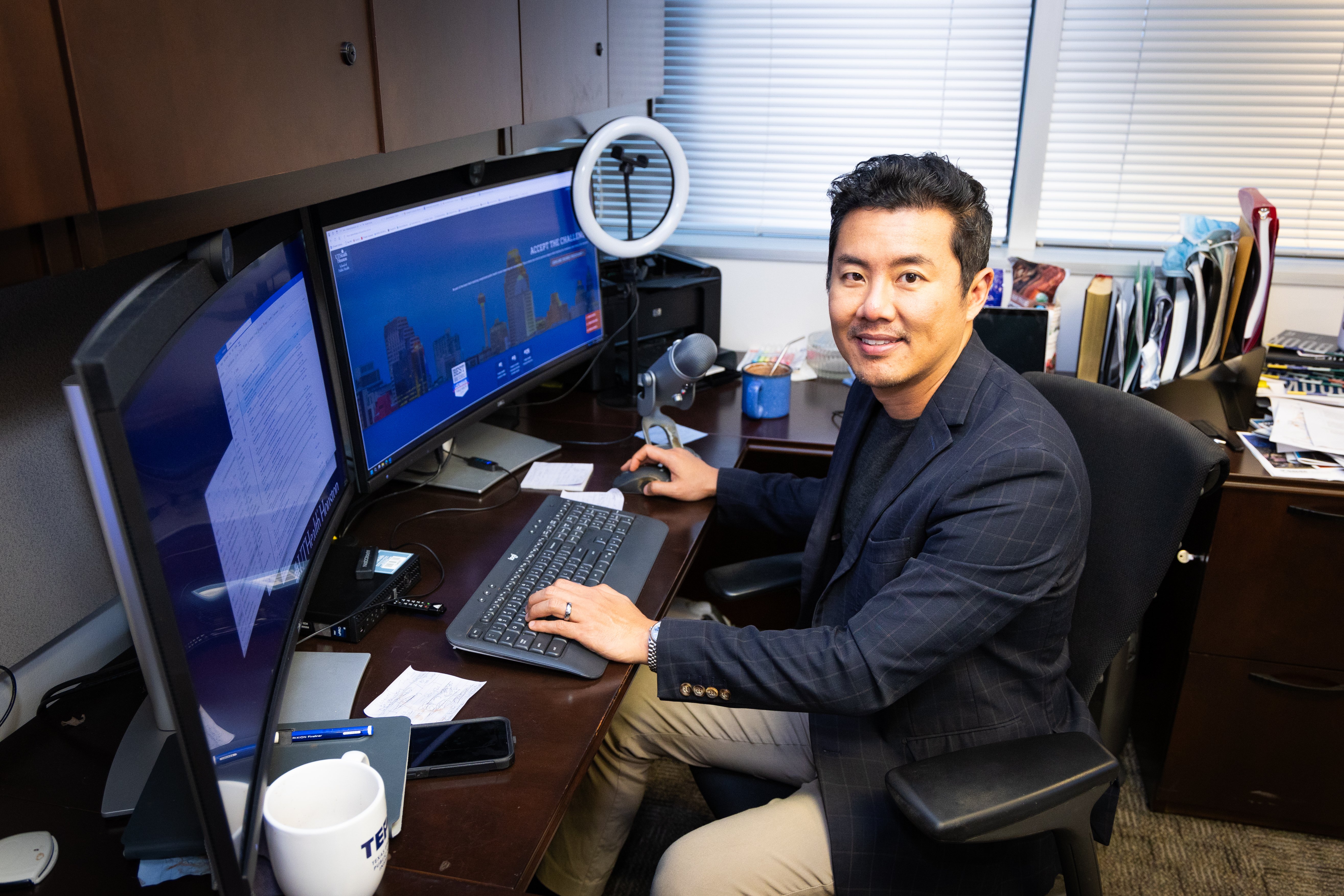
For his innovative and tireless work in researching solutions for homelessness, Jack Tsai, PhD, professor at UTHealth Houston School of Public Health, is receiving the 2026 American Public Health Association’s (APHA) Award for Excellence.
According to the organization, the APHA Award for Excellence is given to members who demonstrate exceptional contributions to the improvement of public health. Since 1872, the association has championed the efforts of public health professionals and worked to become a renowned voice for the field. Tsai will be recognized for his contributions at the 2026 APHA Annual Meeting and Expo in San Antonio, the largest annual public health gathering in the nation.
“Receiving this award is a great honor, and particularly meaningful to be receiving it in San Antonio, where I live and work,” Tsai said. “But my work reflects the efforts of many colleagues, trainees, and mentors around the country over the years. I am grateful for all those I work with, and this award is really a tribute to them."
APHA announced that Tsai is receiving the award in recognition of his extensive research on evidence-based public health solutions to reduce and prevent homelessness. Since joining UTHealth Houston in 2020 as regional director for the school’s San Antonio location, Tsai has collaborated extensively with local homeless services and veteran's organizations on projects ranging from money management classes to hepatitis prevention among at-risk populations.
In addition to his role as a faculty member at the School of Public Health, he serves as research director of the Department of Veterans Affairs National Center for Homelessness Among Veterans and was the former chair of the APHA Caucus on Homelessness and the Association’s Committee on Health Equity. Tsai’s research on interventions such as rapid rehousing and permanent, supportive housing have been instrumental in addressing homelessness over the past decade.
Of all his projects aimed at reducing homelessness, Tsai said he’s probably most proud of a Group-Intensive Peer Support model he developed years ago that encouraged those experiencing homelessness to support each other through the process of exiting homelessness, rather than relying on a case manager to help them. Tsai’s model was evaluated and eventually disseminated nationally through the Department of Veterans Affairs as an effective method for mitigating homelessness among veterans.
Looking ahead to the future of homelessness in the U.S., Tsai sees some new possible causes of homelessness fast approaching with the rapid development and deployment of AI replacing workers. He also sees opportunities for new solutions.
“Unemployment and social disconnection are major risk factors for homelessness, and so new solutions need to be developed to prepare for these risks,” Tsai said. “I believe the more homeless service systems begin integrating and testing ways to use AI in their work, the better prepared they will be to manage AI instead of being managed by AI.”
Tsai plans to continue researching causes and solutions of homelessness, which he describes as a challenging and important public health issue. A safe, stable place to live and sleep at night is fundamental to health and well-being, Tsai said, because it is nearly impossible to maintain health and access to resources without a regular place to live. As a clinical psychologist, he has always been drawn to research homelessness because of the behavioral health challenges so common among those experiencing homelessness.
“The puzzling reality of homelessness has always motivated me,” Tsai said. “We live in the richest country in the world, yet some people do not have a home. How we address homelessness in the country reflects how we, as a nation, take care of our most vulnerable citizens.”