
UTHealth Houston cancer researchers awarded nearly $10M from CPRIT
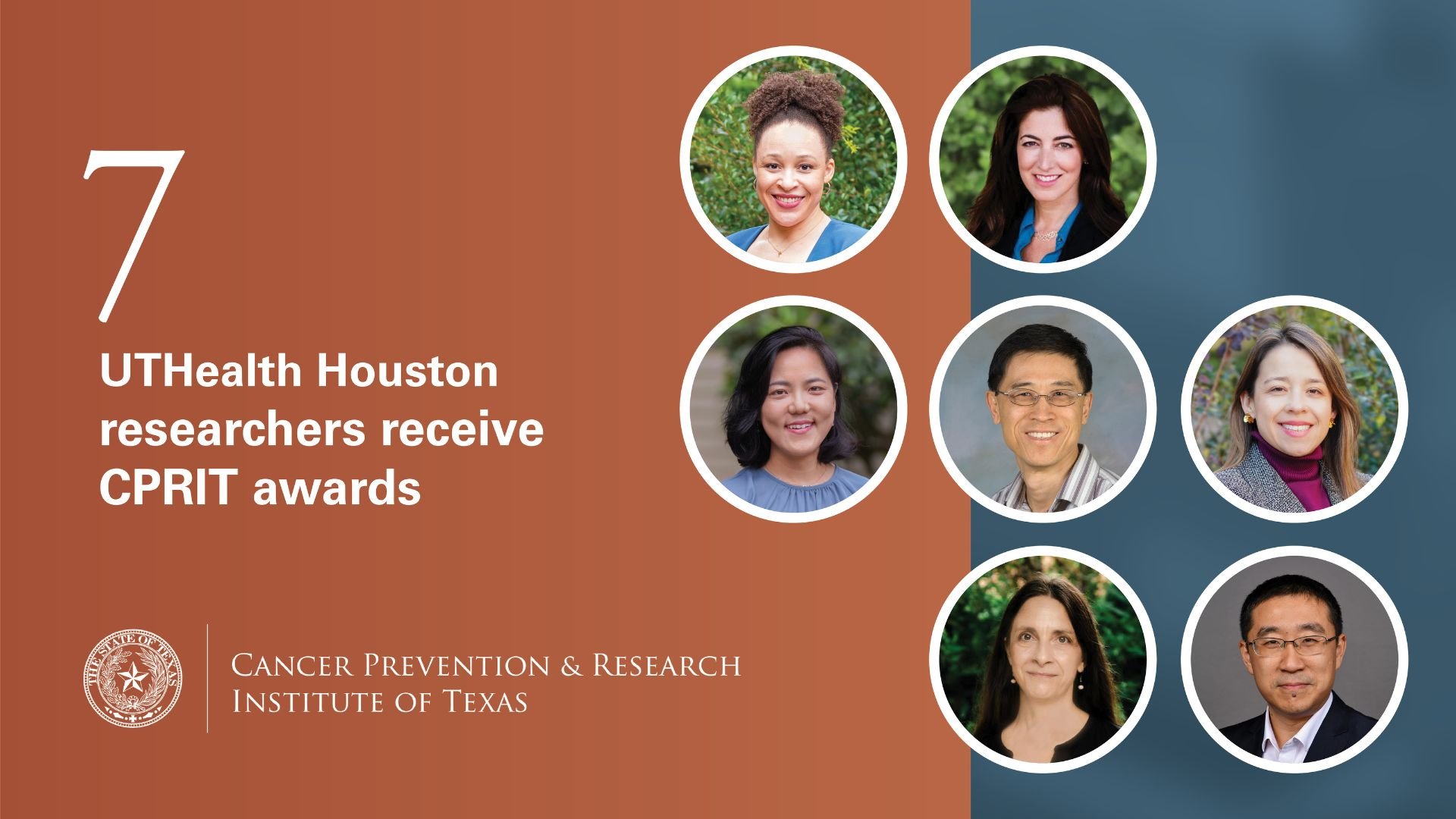
Seven UTHealth Houston researchers received awards totaling nearly $10 million in funding from The Cancer Prevention and Research Institute of Texas (CPRIT), a state legislative initiative designed to advance cancer research and prevention in Texas. The recipients oversee initiatives spanning multiple strategic and beneficial areas within cancer research and prevention.
Five of the grants were led by faculty at UTHealth Houston School of Public Health. Three of those, which total nearly $5 million, were led by researchers from the Center for Health Promotion and Prevention Research in partnership with UTHealth Houston Institute for Implementation Science. McGovern Medical School at UTHealth Houston leads two of the grants focusing on cancer’s effects on the body and potential therapies for treatment.
“This outstanding performance by our talented faculty during this current CPRIT round demonstrates the strength of cancer research across all our schools at UTHealth Houston,” said John Hancock, MA, MB, BChir, PhD, ScD, senior vice president for research strategy and innovation at UTHealth Houston and professor, executive dean, and the John S. Dunn Distinguished University Chair in Physiology and Medicine at McGovern Medical School at UTHealth Houston.
With this recent round of funding, CPRIT’s overall investment in the fight against cancer in Texas surpasses $4 billion, making it the highest-funded state initiative of its kind in the U.S. and the second-largest overall cancer funder after the National Cancer Institute. Founded by legislative action and voter approval in Texas in 2007, CPRIT has since recruited 344 cancer investigators, supported 25 companies relocating or expanding in Texas, and enabled approximately 11.2 million prevention services covering all 254 Texas counties.
These awards further emphasize UTHealth Houston’s continued commitment to advancing both fundamental cancer sciences and access to screening and early detection programs.
Gayla Ferguson, DrPH – School of Public Health
Central Texas Breast Cancer Screening Program - $1,468,647
Gayla Ferguson, DrPH, assistant professor of management, policy, and community health at UTHealth Houston School of Public Health leads this nearly $1.5 million screening program that will focus on identifying and engaging rural and minority women in twelve central Texas counties to provide outreach, education, and mammography screenings. The team will deploy the new mobile mammography unit and provide services to women traditionally deemed nonadherent based on the U.S. Preventative Task Force’s guidelines for mammography screening. The initiative will primarily provide services to rural county residents who live more than 20 miles from a clinic that performs mammography.
“Beyond central Texas women getting lifesaving preventive, diagnostic, and restorative care, I anticipate new partnerships being forged with health care providers, community-based organizations, and faith-based organizations operating in Central Texas, opening the door for all UTHealth Houston School of Public Health locations to support and assist these communities,” said Ferguson.
In addition to making screenings accessible to these communities, potentially leading to early detection and diagnosis, Ferguson suggests the initiative will further emphasize the importance of public health professionals. “I also hope Texans will get a more accurate view of the dedication and hearts of public health practitioners,” she said.
Jooyeon Hwang, PhD – School of Public Health
Protecting Those Who Protect Us: On-Scene Decontamination for Texas Firefighter Cancer Prevention – $1,200,000
Jooyeon Hwang, PhD, associate professor of environmental health and occupational sciences, at the School of Public Health was awarded $1.2 million to examine how carcinogens in fire smoke increase the risk of cancer in firefighters. The initiative will assess whether immediate actions, referred to as decontamination, such as cleaning gear, wiping the skin, and rinsing the nose, after a fire can reduce the effects of inhaled carcinogens. Researchers will follow firefighters over time to track how consistently they use decontamination practices and whether those practices lower the levels of carcinogens in their bodies.
“This approach could lead to new fire department policies and protect thousands of firefighters across Texas and beyond. By providing direct evidence that simple practices can reduce cancer-causing exposures, this initiative moves us one step closer to ensuring firefighters do not have to sacrifice their long-term health to save lives,” said Hwang.
María E Fernández, PhD – School of Public Health
ACCESS: Advancing Colorectal Cancer screening in East and South TX Systems – $1,469,982
Led by a multidisciplinary team from UTHealth Houston, ACCESS will work in collaboration with Federally Qualified Health Centers and community partners to reduce screening disparities and improve early detection and prevention of colorectal cancer. The project will embed evidence-based strategies into routine clinical practices, including provider reminders, patient navigation, and system-level workflow improvements. ACCESS will also increase community and patient awareness about the importance of screening and provide tools to overcome barriers to care. By leveraging the statewide infrastructure and partnerships of UTHealth Houston Institute for Implementation Science and the Center for Health Promotion and Prevention Research, this initiative aims to improve early detection and reduce colorectal cancer morbidity and mortality across Texas.
“This prevention services grant will embed proven interventions into existing health systems to make sure we are doing all we can to prevent and control colorectal cancer,” said María E. Fernández, PhD, vice president of population health and implementation science at UTHealth Houston, co-director of the Institute for Implementation Science, and a professor and Lorne Bain Chair in Public Health and Medicine at the School of Public Health. “Such improvements are critical for Texas, which ranks among the lowest in colorectal cancer screening. By working closely with our clinical and community partners, we’ll improve prevention and early detection for this common cancer and reduce the burden for Texans — particularly those in communities facing the greatest barriers to care. In the long term, this project will create sustainable models that can be scaled statewide, ensuring a lasting impact on population health.”
Fernandez also serves as director for the Center for Health Promotion and Prevention Research.
Xin Ge, PhD – McGovern Medical School
Efficient BBB Penetration of Antibody-Drug Conjugates for Improved Treatment of Brain Metastases - $900,000
Xin Ge, PhD, professor of molecular medicine and Kay and Ben Fortson Distinguished Chair in Neurodegenerative Disease Research at McGovern Medical School at UTHealth Houston, received $900,000 for his project that aims to develop brain-penetrating therapies for metastatic cancer.
Ge’s research addresses the growing challenge of brain metastases, a complication that has become more common as systemic cancer treatments improve. His project focuses on developing brain-penetrating antibody-drug conjugates designed to cross the blood-brain barrier and more effectively treat HER2+ breast cancer and EGFR+ lung cancer that spread to the brain.
“Most patients and their families fear brain metastases and feel quite hopeless as they know that once cancer moves to the brain the possibility of successful treatment is low,” Ge said. “I believe this project is very important because it addresses a critical and underexplored barrier in oncology – the inability of most antibody-based therapeutics to achieve effective concentrations in brain metastases. If successful, it could fundamentally shift therapeutic strategies for HER2+ breast cancer, EGFR+ lung cancer, and other CNS malignancies.”
Yi-Ping Li, PhD – McGovern Medical School
Mechanism of Cancer Induction of Striated Muscle Wasting - $900,000
Yi-Ping Li, PhD, professor in the Department of Integrative Biology and Pharmacology at McGovern Medical School, received $900,000 for a project that explores how cancer disrupts the body’s ability to rebuild muscle and tests for a pathway for reversing the muscle-wasting effects of cancer cachexia.
Li’s project investigates how the p38β MAPK pathway drives anabolic resistance by mapping its signaling mechanisms and confirming its effects in deidentified muscle biopsy samples from cancer patients. Li will also evaluate whether existing drugs that inhibit p38β MAPK can reverse this resistance, laying the groundwork for new therapeutic strategies.
“Previous efforts in cancer cachexia research were largely focused on skeletal muscle catabolism. How cancer impairs skeletal muscle anabolism has remained poorly understood,” Li said. “Mitigating the impairment of skeletal muscle anabolism by cancer is particularly important for reversing muscle wasting, which requires restoration of muscle mass and function. The success of the current project will pave the way to clinical testing for intervening cancer-induced anabolic resistance and muscle wasting by repurposing existing drugs.”
Andrea Ramirez Varela, MD, PhD, MPH – School of Public Health and McGovern Medical School
Boosting Breast and Colorectal Cancer Prevention Through Physical Activity Assessment, Prescription, and Referral Into Clinical Care Among Communities in Need - $978,714
Led by Andrea Ramirez Varela, MD, PhD, MPH, assistant professor of epidemiology and Timothy Walker, PhD, assistant professor of health promotion and behavioral sciences, this nearly $1 million award aims to increase physical activity and improve prescriptions and referrals in rural clinics across South Texas. Ramirez Varela and Walker will work with and train health care staff in rural communities to improve electronic health records, establish strong partnerships with community organizations, and develop a sustainable system that encourages patients to become more physically active. This initiative will primarily focus on reducing the risk of breast and colorectal cancer, while also strengthening the overall quality of preventive care.
The team will partner with community health workers to further support patients, guiding them toward local exercise opportunities and help them stay active long term.
“Patients in these rural communities will receive personalized guidance to become more physically active, which can lower their risk of breast and colorectal cancer,” said Ramirez Varela.
“Most of all, we look forward to the positive impact this initiative will have on patient health and look forward to developing a means for this to be a cost-effective and scalable model that can be used in other communities across Texas,” she said.
Lara Savas, PhD – School of Public Health
Adaptation and Implementation of an Evidence-Based CHW-Delivered Program to Increase Breast and Cervical Cancer Screening and Prevention Among Texas Women - $2,449,802
The major public health initiative Health in My Hands aims to increase breast and cervical cancer screening and prevention among medically underserved women throughout Texas. The project will rapidly adapt the evidence-based Salud en Mis Manos interventions, originally developed for low-income Latinas. Serving as primary investigator for the project is Lara Savas, PhD, associate professor, along with Paula Cuccaro, PhD, associate professor, as co-primary investigator, both with the Department of Health Promotion and Behavioral Sciences at the School of Public Health.
Expanding on the Salud en Mis Manos reach and continuing efforts, Health in My Hands will cover 15 new counties and 23 total counties across East and northeast Texas, the Panhandle, and the Greater Houston area, working in close partnership with Civic Heart Inc. and The University of Texas at Tyler. The initiative prioritizes uninsured and underinsured women, helping participants to overcome personal and structural challenges by providing community health worker-delivered education and navigation services to safety-net clinics and mobile providers. “This initiative ensures no woman is left behind in cancer prevention and early detection,” said Savas.
Additionally, the Health in My Hands team will train 200 community health workers and will launch a social marketing campaign projected to reach more than 250,000 Texans with information about cancer prevention and early detection. “By expanding the evidence-based program, community health workers and health coach navigators will offer behavioral education and navigation support to help women receive recommended screenings and prevention services,” Savas said. “By training and developing community health workers’ knowledge and understandings of the program, we aim to increase both impact and program sustainability.”