
Here to Support Your Research
Working with health care data can feel complex—but you don’t have to do it alone. Our team turns raw claims data into clear, useful insights. We apply enhancements, such as risk scores, chronic condition indicators, and episodes of care, so you can focus on your research questions—not data cleanup.
If you need more support, our experts are here to help every step of the way. We can guide you in choosing the right dataset, selecting the best codes for your study, and a delivering high-quality analysis aligned with your goals. We also create easy-to-understand visuals—maps, dashboards, and presentation materials—that help you share your findings with confidence and impact.
What We Offer

Data Access
Claims datasets, EMR, state datasets, custom extracts.

Analytical & Technical Services
Modeling, analytics, visualization, programming.

Project Support & Consultation
Project management, evaluation services, strategy.
Make Claims Data Work for You: Key Considerations
Claims data can offer valuable insights that work best when your project is well defined. Consider the following recommendations:
- Conduct a literature review to understand how claims data has been applied in prior research or evaluation projects.
- Define your study population with clear inclusion/exclusion criteria.
- State your research question and specify if it involves:
- Rare conditions
- Trend analysis
- Intervention evaluation
- Cost analysis
- Identify necessary diagnosis/procedure codes (requestor is responsible for selection).
- Outline roles and a scope of work that includes all parties.
- Plan your budget and funding sources.
- Review requirements for datasets access and ensure you meet them.
Use Cases & Impact
We’re passionate about turning data into actionable insights. By partnering with stakeholders across sectors, we make claims data accessible, meaningful, and transformative. Here’s how our collaborations drive real-world impact:

Population Level
A retrospective cohort study using a commercial claims database from 2011 to 2014 to evaluate the prevalence of potentially harmful drug (PHD) prescriptions among patients diagnosed with systolic heart failure.


Frequently Asked Questions
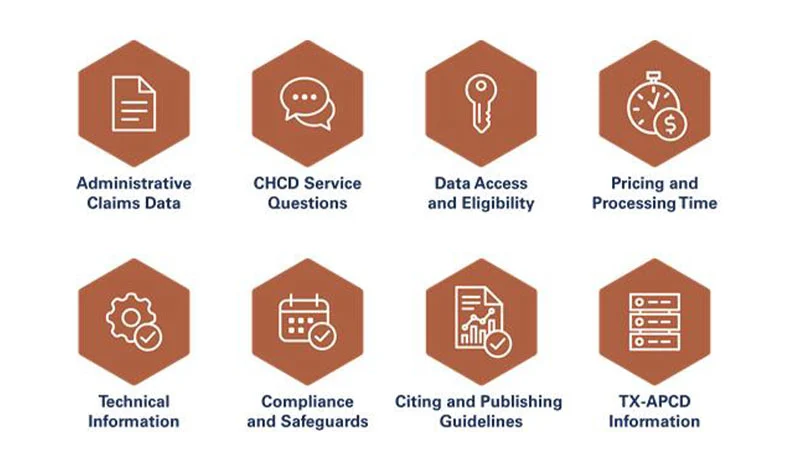
Need a quick answer? Find detailed information about our data services, data access, costs & timelines, technical questions, and security & compliance.

The Center for Health Care Data is located at The University of Texas Health Science Center at Houston (UTHealth Houston) School of Public Health